Most people, at this point, have been to a wedding ceremony or at least seen one on TV. But what is a Handfasting? If you have seen the TV show Charmed, you may have heard them talk about it when Piper and Leo were married. They found a page in their Book of Shadows that discussed the Pagan Marriage Rite led by a High Priestess. When Piper and Leo married, their Grams led the Handfasting ceremony. Quite frankly, I haven’t seen many other representations of Handfasting in Media.
So, what is a Handfasting?
Shockingly, the ceremony of Handfasting dates all the way back to 1200 A.D., in the British Isles and Europe as the primary type of wedding. When they were originally performed, the marriage only lasted for a year and a day as a way to bring rival tribes together. If they did not want to stay together after the trial period was over, they would do an untying ceremony and be on their way. They could also choose to stay together after the year and a day. At that point, the couple would make their marriage legitimate, and any children they had during this period would be legitimate.
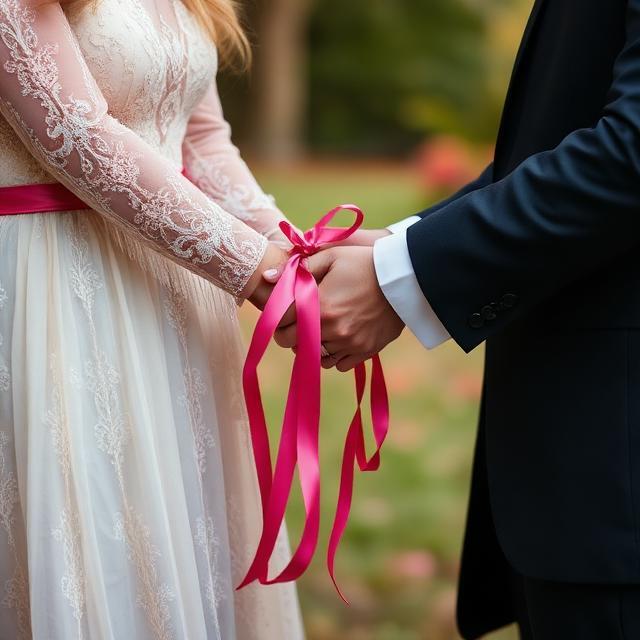
This is where the term “tying the knot” comes from. During a handfasting, the bride and groom’s (or groom/groom, bride/bride) hands are tied together using a rope.
In these modern times, Handfasting is a common way for pagans or other spiritual people to get married. Some people choose the handfasting ceremony just for the ceremony itself and its history. Others will utilize a celebrant (officiant) to make the marriage legal.
What will you see if you attend a Handfasting?
You will still see similar elements of a more traditional wedding: saying vows, being announced as husband and wife, etc. But there are going to be additions as well. For instance, you will likely see an altar where the celebrant, bride, and groom stand. The altar may have symbols, like the pentagram, candles, rope or cord for tying hands, incense, a wand or athame, or other tools needed for the marriage rite.
The celebrant will cast a circle around the party for protection. They may use salt (or chalk if outside), water, or even fire/smoke to make a physical circle. Once the circle is cast, the celebrant will call on the four elements and the corners (earth/North, air/East, fire/South, and water/West) and a possible deity (god/gods) to bear witness to the marriage. If the couple has a specific god that they worship, they would be called. If not, a god of marriage or love may be invoked. If the couple does not have a specific deity they worship, they may also choose not to invoke any gods or goddesses.
The rest of the ceremony will begin once all entities have been called to the circle. The couple will begin with the vows they say and exchange rings if they desire to do so. Some pagans may not exchange rings and exchange something else entirely. Then, the celebrant will tie their hands together. They will stay that way through the rest of the ceremony.
Once the main ceremony has been completed, the celebrant closes the circle. Closing a circle entails saying goodbye to any entity they brought into the circle to witness the marriage. That would include any deities, the elements, and the corners (cardinal directions). Once the entities have left and the circle is opened again, the celebrant will ask the bride and groom to jump over a broom (if it was included in their wedding). The bride and groom are announced, and the cords are untied (in several versions of handfasting). Although they are being untied in the ceremony, their love and lives are now intertwined for as long as they wish to remain.
Overall, Handfasting is very similar to any other marriage ceremony in its main aspect. It is two people who love each other, who intend to dedicate their lives together in front of friends and family. Handfastings have a rich history, dating back almost a thousand years. Have you born witness to a Handfasting?
Leave a Reply